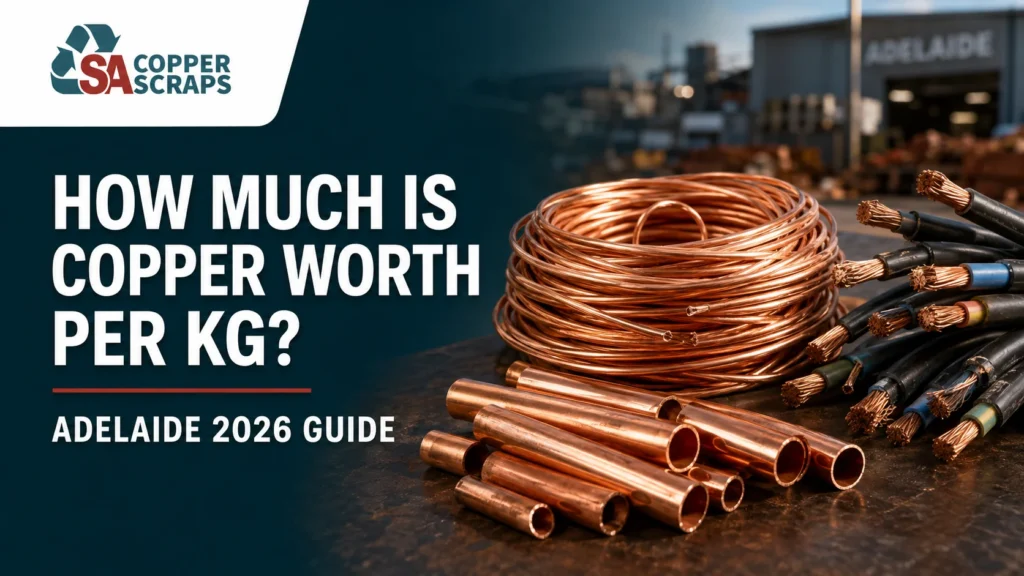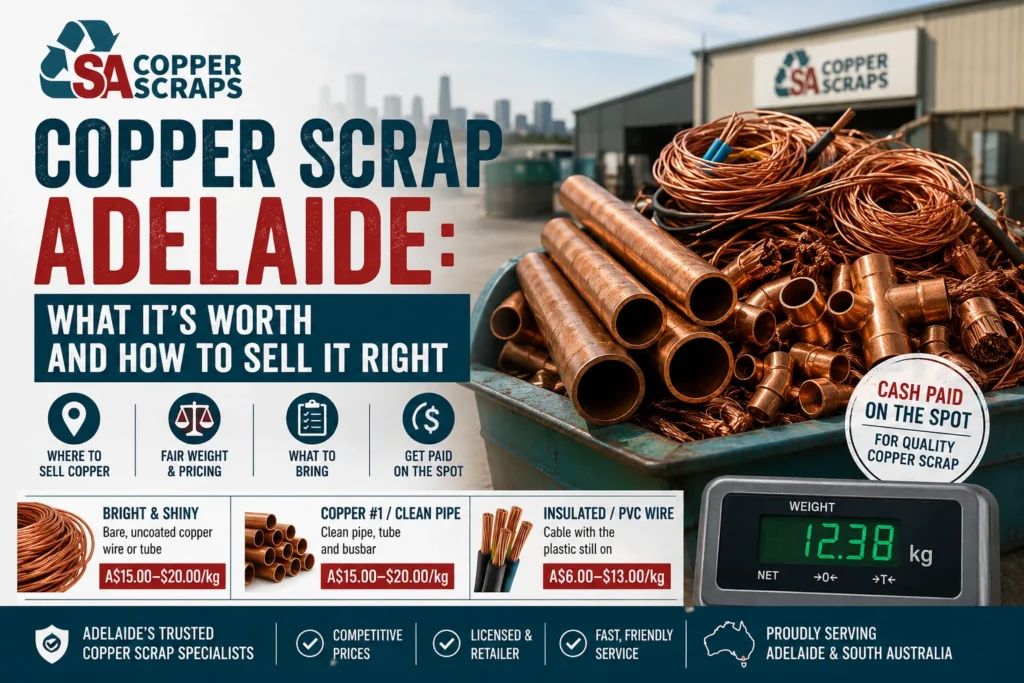
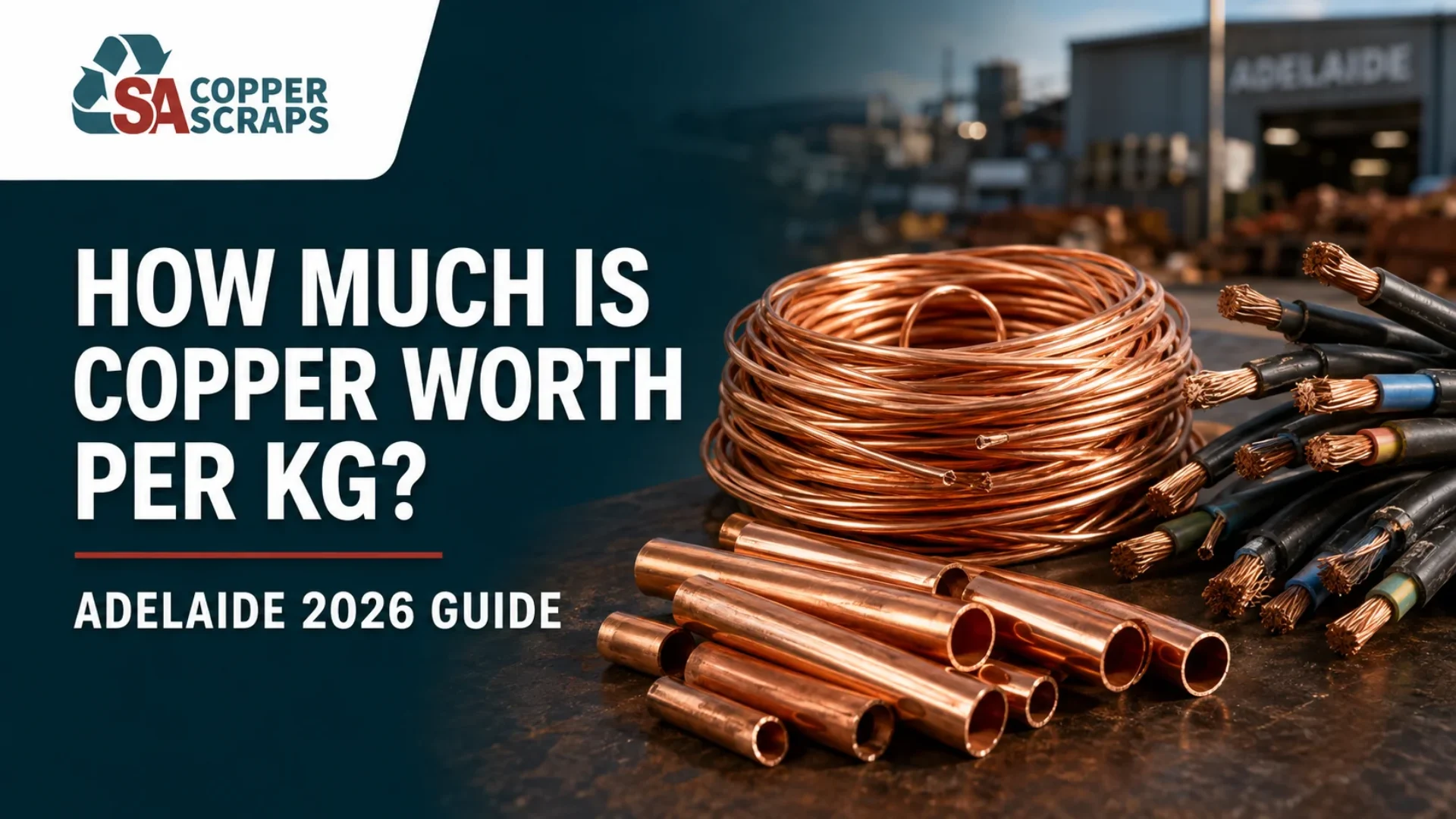
Clean bare bright copper is worth roughly A$15.00–$20.00 per kilogram in Adelaide, #1 copper pipe about the same, and insulated PVC wire A$6.00–$13.00 per kilogram. But those are rates, not answers. What you actually get paid is your weight multiplied by your grade — and most people misjudge the grade, not the weight.
This guide shows you how to work out what your specific load is worth before you drive anywhere, using the three things that decide it: what grade you have, what it weighs, and what comes off for contamination.
The short answer
Copper value per kilogram is set by one factor above all others: grade. The same 10kg of copper can be worth A$150 or A$60 depending on whether it is bare bright wire or insulated cable. Weight is simply the multiplier.
Current Adelaide benchmarks by grade:
| Copper grade | Indicative rate per kg | What 10kg is worth |
| Bare bright / bright & shiny | A$15.00–$20.00 | A$150–$200 |
| #1 copper (clean pipe, tube, busbar) | A$15.00–$20.00 | A$150–$200 |
| Insulated PVC copper wire | A$6.00–$13.00 | A$60–$130 |
Rates reviewed 24 June 2026. For the current in-store figures see our copper scrap price page or call 08 7225 9998 — copper moves daily and any published range is a guide, not a quote.
Why copper is priced by grade, not by weight alone
A refinery buying your copper has to turn it into usable metal. Every contaminant — insulation, solder, paint, brass fittings, oxidation — is something that has to be separated out first, and that processing cost comes off what the yard can pay you.
That is the entire logic of grading. It is not a negotiating position and it is not arbitrary. A yard paying the same rate for bare bright wire and painted, soldered pipe would be losing money on the second one.
It also means grade is worth more of your attention than weight. You cannot change what your copper weighs. You can often change what grade it is classified as, simply by sorting it properly before you arrive.
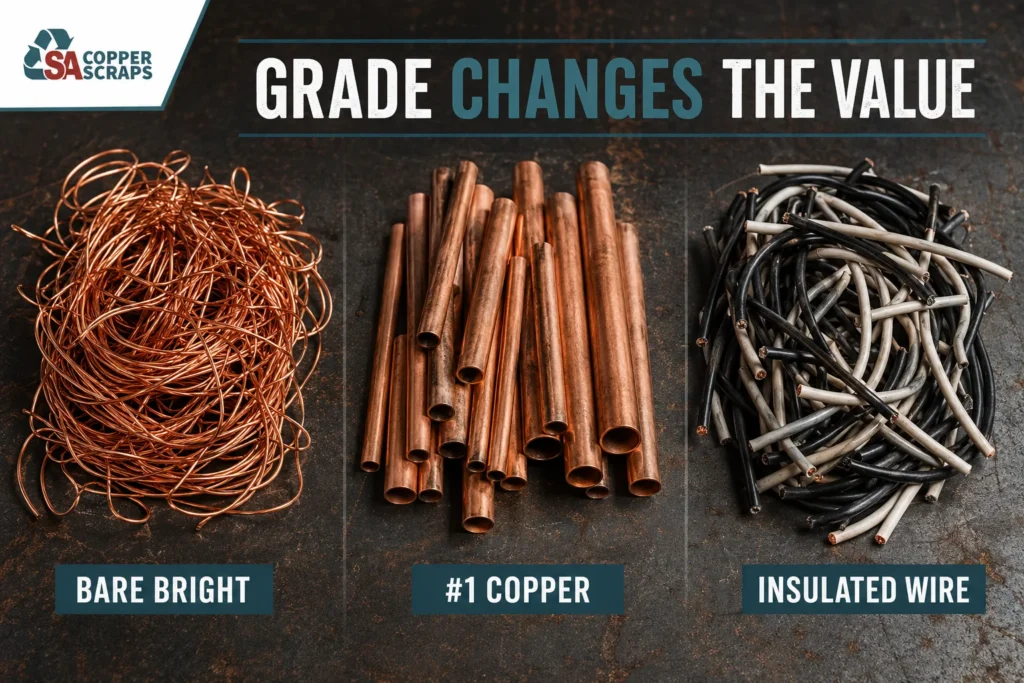
Bare bright (bright & shiny)
The top grade. Bare, uncoated copper wire, unoxidised, generally thicker than about 1.6mm. It should look genuinely reddish-orange like a new coin — no dulling, no green tinge, no coating. Stripped electrical cable in good condition lands here.
#1 copper
Clean copper tube, pipe and busbar with no solder, paint, fittings or heavy corrosion. Plumbing offcuts are the classic example, provided the joints and fittings have been cut off.
#2 copper
The same material as #1 but carrying solder, paint, light corrosion or attached fittings. Copper pipe with the joints still on sits here. This is the grade most people accidentally fall into, and it is why cutting fittings off pays for itself.
Insulated and PVC wire
Cable with the plastic still on. The rate depends on copper recovery — how much actual copper comes out relative to the total weight. Heavy single-core cable with a thick conductor prices well above thin flex with a heavy jacket. Our cable scrap price guide covers this in detail.
Working out what your load is worth
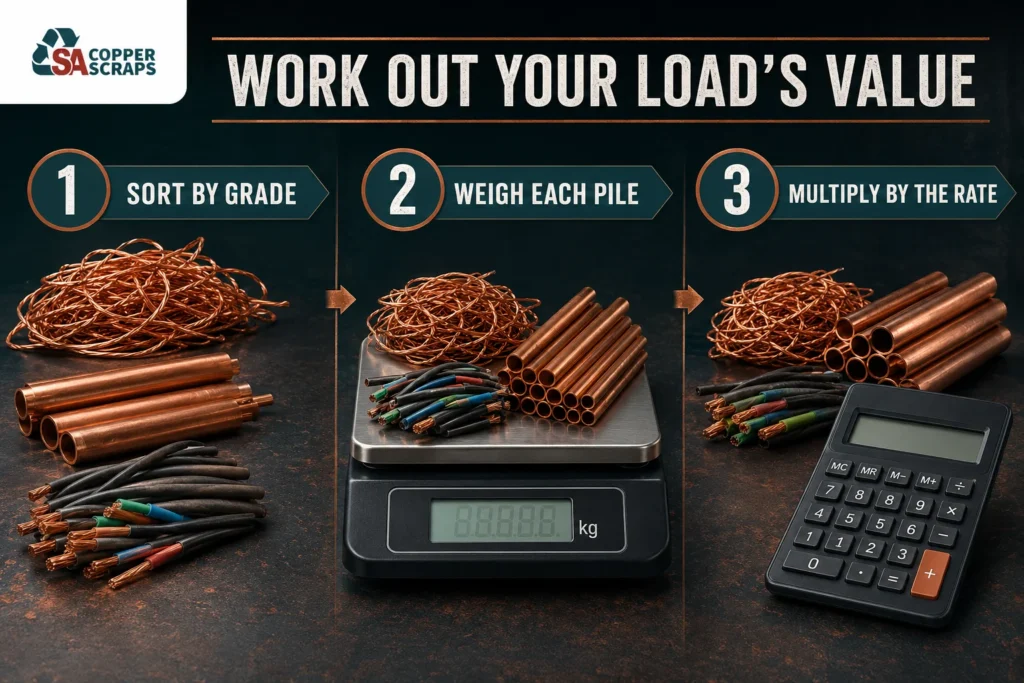
Three steps, and you can do all of them at home.
Step 1 — Separate by grade
Put bare wire in one pile, clean pipe in another, insulated cable in a third, and anything with fittings or paint in a fourth. This single step is what determines whether your load is valued at the top rate or averaged down.
Mixed loads get graded toward their lowest-value contents. A bin holding 8kg of bare bright and 2kg of painted pipe may be assessed closer to the lower grade than the higher one, because the yard cannot separate what it cannot see.
Step 2 — Weigh each pile
Bathroom scales are accurate enough for an estimate. Stand on them holding the pile, then subtract your own weight. You are not looking for precision here — you are looking for a realistic expectation before you drive.
Step 3 — Multiply and subtract
Multiply each pile by its grade rate, then subtract for anything you know is contaminated. Some worked examples:
| What you have | Likely grade | Rough value |
| 5kg of stripped bare copper wire | Bare bright | A$75–$100 |
| 12kg of clean copper pipe, fittings removed | #1 copper | A$180–$240 |
| 12kg of copper pipe with brass fittings still on | #2 copper | Noticeably less than the above |
| 20kg of household electrical cable, insulation on | Insulated PVC | A$120–$260 |
| A full hot water cylinder (copper tank in steel jacket) | Assessed on recovery | Call first |
These are estimates to set expectations, not quotes. The final figure is confirmed after the material is graded and weighed on calibrated scales at the yard.
Why the “copper price” you see online is not what you get paid
This trips people up constantly, and it is worth understanding before you feel short-changed.
Search “copper price” and you will find figures around A$18–$19 per kilogram. That is the spot price — the price of refined, exchange-grade copper traded on international markets, quoted in US dollars and converted to Australian dollars.
Your scrap is not refined exchange-grade copper. It is used material that still has to be collected, sorted, transported, processed and refined before it becomes that. The scrap payout rate sits below spot for that reason, and the gap between them is where all of that work happens.
A useful way to think about it: spot price tells you which direction rates are moving. Grade tells you where in that range your material sits. When copper rises globally, Adelaide scrap rates follow with a lag. When the Australian dollar weakens, local rates rise even if the world price has not moved, because copper is priced internationally in USD.
Our guide to what actually sets the copper scrap rate covers the market side in more depth.
Checking it is actually copper
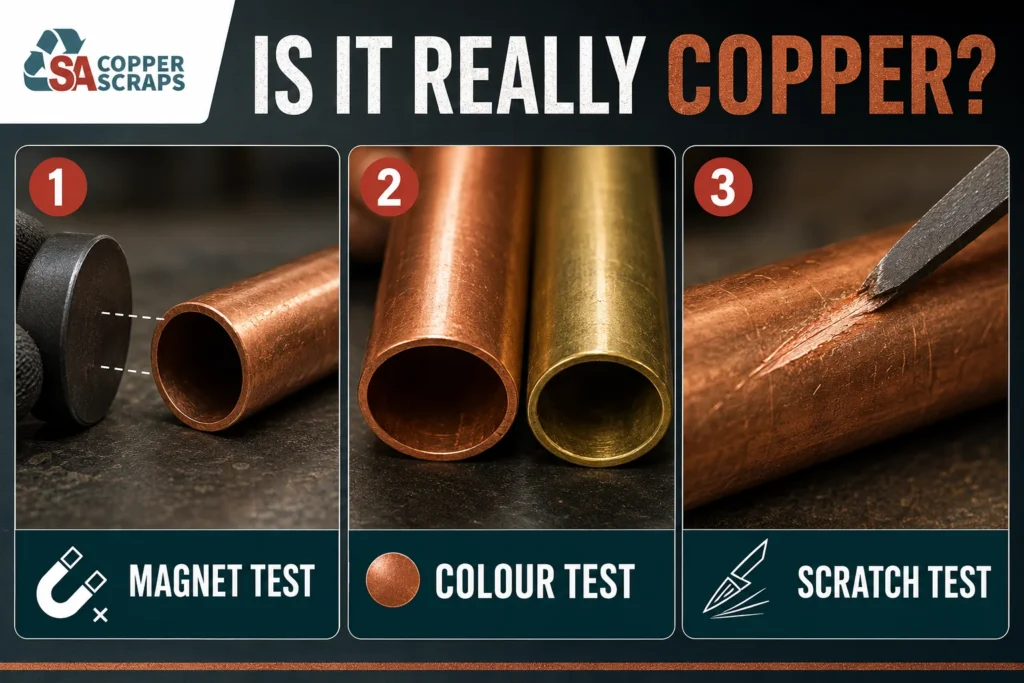
Before calculating anything, confirm what you have. Three tests, no equipment:
- Magnet test. Copper is not magnetic. If a magnet sticks, it is steel — possibly copper-plated steel, worth a fraction of the rate.
- Colour test. Copper is reddish-orange. Yellow-gold means brass, which is valuable but prices lower. Browner tones suggest bronze.
- Scratch test. Scratch an inconspicuous spot. Solid copper is the same colour all the way through. A different metal underneath means it is plated.
Where copper hides
Most households have more than they think. The common sources, roughly in order of how much copper they hold:
- Plumbing offcuts — the single most common source we see, usually from renovations and hot water replacements.
- Electrical cable — rewiring offcuts, old extension leads, cable drums.
- Hot water cylinders — many older units hold a copper tank inside a steel jacket.
- Air conditioner coils — split system coils are copper. See aircon unit prices.
- Electric and starter motors — the windings are copper, though these are priced as motors rather than raw copper.
- Radiators — older car and industrial radiators combine copper tubes with aluminium fins. See radiator prices.
Five things that change what you are paid
- Sorting. The highest-value ten minutes of the whole job. Mixed loads are averaged down.
- Cutting fittings off. Brass joints and solder drop clean pipe from #1 to #2.
- Stripping cable — sometimes. Worth it for a drum of heavy cable, rarely worth it for a handful of thin flex.
- Keeping it dry. Wet material weighs more but grades worse, and yards account for it.
- Not burning insulation. It is illegal, releases toxic fumes, and oxidises the copper underneath. Burnt copper grades down, never up.
Selling copper in Adelaide
At SA Copper Scraps, 12 Belfree Dr, Green Fields SA 5107:
- Sort your copper by grade at home.
- Call 08 7225 9998 with rough weights per grade for guidance before travelling.
- Bring it in with photo ID during opening hours — Mon to Fri 7:30am–5:00pm, Sat 7:30am–2:00pm.
- It is graded and weighed on calibrated scales while you watch, and paid before you leave.
We also buy the full range of scrap metals — see the scrap prices hub for every material, or our guide to what scrap metal is worth by material if your load is mixed.
Frequently asked questions
How much is copper worth per kg in Adelaide?
Clean bare bright copper and #1 copper pipe sit around A$15.00–$20.00 per kilogram on current Adelaide benchmarks, with insulated PVC wire from about A$6.00–$13.00 per kilogram. Grade matters more than weight — the same 10kg can be worth A$150 or A$60 depending on what it is.
How do I work out what my copper is worth?
Separate it by grade, weigh each pile, then multiply by the rate for that grade. Bare wire and clean pipe sit at the top rate, insulated cable well below it. Subtract for anything carrying paint, solder or attached fittings.
Why is the copper price online higher than what a scrap yard pays?
Online figures around A$18–$19 per kilogram are the spot price for refined, exchange-grade copper traded internationally. Your scrap still has to be collected, sorted, transported and refined before it becomes that. The scrap payout sits below spot because that processing has to be paid for.
What is the difference between bare bright and #1 copper?
Bare bright is uncoated, unoxidised copper wire with no corrosion. #1 copper is clean pipe, tube and busbar with no solder, paint or fittings. Both are top grades — the distinction is wire versus tube and the absence of any surface dulling.
Does the weight or the grade matter more?
Grade. Weight is the multiplier, but grade sets the rate being multiplied. You cannot change what your copper weighs, but sorting it properly can move it up a grade — which is why sorting is worth more than anything else you can do.
Is it worth stripping insulation off copper wire?
For heavy cable with a thick conductor, usually yes, because bare copper pays at the top rate. For thin flex or small quantities the labour rarely pays for itself. Never burn the insulation off — it is illegal and damages the copper.
How can I tell if something is really copper?
Copper is not magnetic, so a magnet sticking means steel or copper-plated steel. Copper is reddish-orange rather than yellow, which usually indicates brass. Scratching an inconspicuous spot reveals a different metal underneath if the item is only plated.
Do copper prices change daily?
Yes. Copper trades on international markets and moves daily, and the Australian dollar affects the local rate independently. Any published range including the one on this page is a guide — call for the rate on the day before bringing in a large load.
What lowers the value of a copper load?
Attached brass fittings, solder, paint, insulation, oxidation, moisture, and mixing grades together in one container. Each moves the material down a grade or causes the load to be averaged toward its lowest-value contents.
Where can I sell copper in Adelaide?
SA Copper Scraps buys copper at 12 Belfree Dr, Green Fields SA 5107. Material is graded and weighed on calibrated scales in front of you, and payment is made before you leave. Bring photo ID.
The ten minutes that decide it
Copper is the highest-value metal most people will ever have in their shed, and the difference between a sorted load and a mixed one is real money — often more than the difference a few extra kilos would make.
Separate the bare from the insulated, cut the fittings off the pipe, keep it dry, then call for the rate before you drive.
Call 08 7225 9998, or check current copper scrap prices.