Search “catalytic converter scrap price” and you’ll find pages confidently telling you a small car converter is worth $50 to $250 and a hybrid is worth up to $1,500. Those numbers get repeated across dozens of sites.
Here’s the problem: a range that wide isn’t a price. It’s a shrug. Told your converter is worth “somewhere between $50 and $1,500,” you know nothing you didn’t know before — and you walk into a yard with no idea whether the offer in front of you is fair.
This guide takes a different approach. Instead of a made-up range, it explains the system that actually determines the number, so you can work out roughly where your unit sits and recognise a fair offer when you see one.
Quick answer
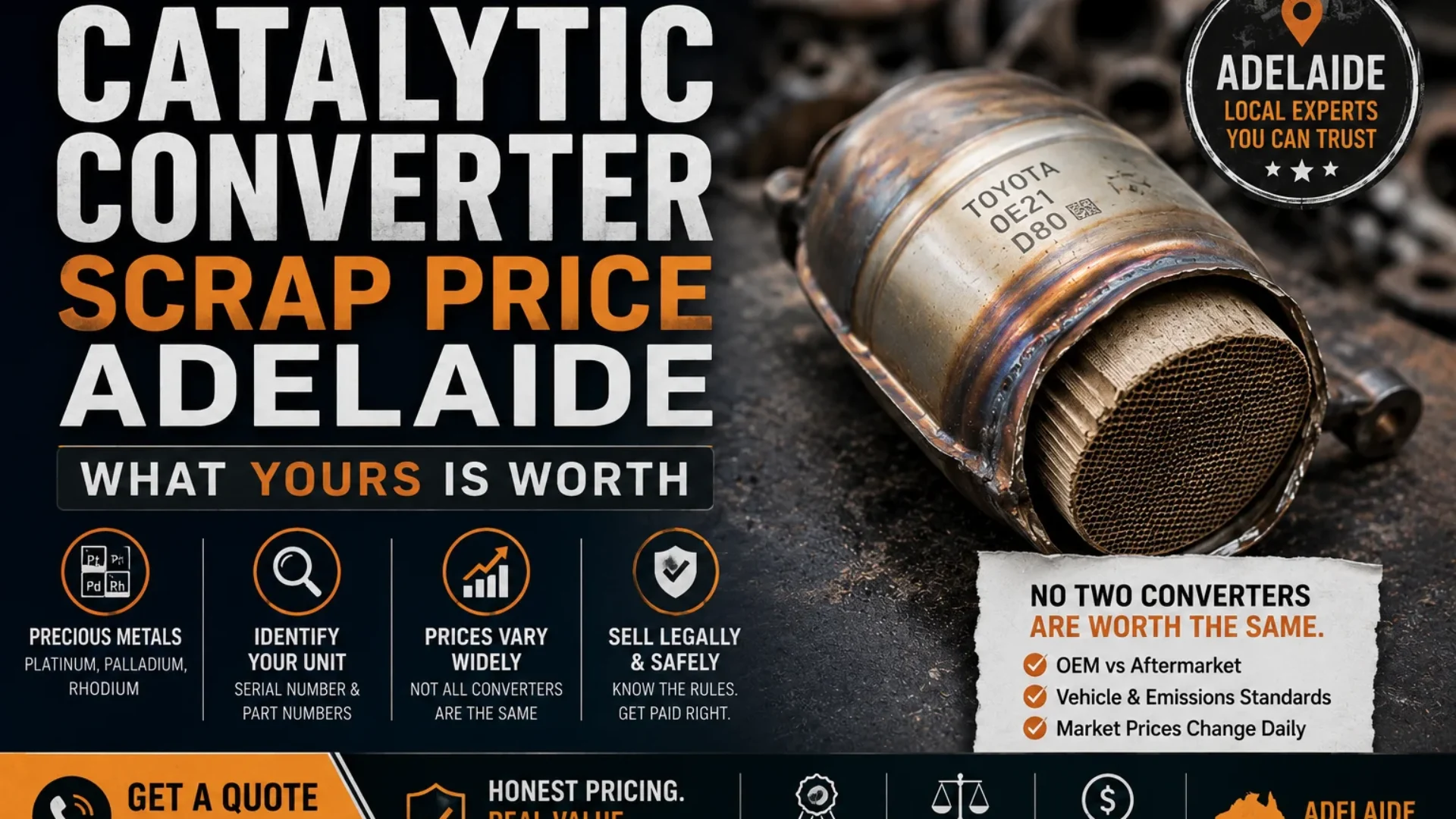
A catalytic converter’s scrap value is set by the platinum, palladium and rhodium recovered from the ceramic honeycomb inside it. Two things drive that: which unit it is (identified by the serial number on the shell) and where the precious metal market sits the day you sell.
Everything else — vehicle type, size, whether it’s OEM — matters only because it predicts those two things. That’s why any buyer quoting a firm figure without seeing the serial number is guessing, and why we quote per unit rather than publishing a headline range.
Why converters have value at all
A catalytic converter sits in your exhaust system and converts harmful gases into less harmful ones. Inside the steel shell is a ceramic honeycomb — thousands of narrow channels — coated in a thin wash of precious metals that trigger those reactions.
That coating is the whole story. Total precious metal content in a single converter is measured in grams, not kilograms. But platinum, palladium and rhodium are valuable enough that a few grams is worth real money. The steel shell around it, by comparison, is worth close to nothing.
The three metals
- Platinum (Pt) — used in both petrol and diesel converters, and the longest-standing component of the catalyst coating.
- Palladium (Pd) — dominant in petrol converters. Manufacturers shifted heavily toward palladium over recent decades as its relative cost changed.
- Rhodium (Rh) — present in the smallest quantities of the three, but historically the most valuable per gram by a wide margin. Rhodium is a major reason converter values differ so sharply and move so unpredictably.
These three are known collectively as PGMs — platinum group metals. They trade on separate markets with separate supply and demand, which is why converter values don’t move in a neat line with any single commodity.
What actually determines your converter’s value
Six factors, roughly in order of impact.
1. OEM or aftermarket
The single biggest variable. A factory-fitted converter was engineered to pass a specific emissions standard, and the manufacturer loaded in whatever catalyst was needed to do that. Aftermarket replacement units are built to a price point and typically carry substantially less.
An OEM unit and an aftermarket unit that look nearly identical can differ in value by a large multiple. If you know which yours is, say so when you call.
2. The specific unit — via the serial number
Every converter carries a serial number stamped or printed on the shell. That number identifies the exact unit and what it was built with. It is the difference between a real answer and a guess.
3. Vehicle, engine and fuel type
Larger engines generally needed more catalyst material. Diesel systems are constructed differently from petrol. A converter off a large sedan or a 4WD usually holds more than one off a small hatchback — though there are exceptions worth checking rather than assuming.
4. Model year and emissions standard
Australian emissions rules tightened progressively through the ADR (Australian Design Rules) framework, and catalyst loadings changed with them. Two converters from the same model line but different build years can differ meaningfully.
5. Internal condition
The recoverable material is in the ceramic honeycomb. If it’s cracked, crumbled, or has been removed, the assessment changes completely. An intact unit is worth substantially more than an empty shell.
6. Where the PGM market sits today
Platinum, palladium and rhodium each trade independently. Rhodium in particular has a history of dramatic swings. A converter can be worth noticeably more or less than it was a month earlier without anything about the unit changing.
Why we don’t publish a headline price range
You’ll notice this guide hasn’t given you a dollar figure. That’s deliberate, and worth explaining.
A range like “$50 to $1,500” is technically true and practically useless. It spans nearly every converter ever made. Quoting it would make this page look more helpful while telling you nothing — and it would set expectations that the unit in your boot may not meet.
What we can do instead is give you a real figure for your unit. Call 08 7225 9998 with the serial number and the vehicle it came off, and you’ll get guidance grounded in that specific converter rather than an average of everything. Current benchmarks for the materials we buy are on our catalytic converter scrap price page.
How to identify your converter before you call
Five minutes of preparation changes the conversation entirely.
Find the serial number
Look on the metal shell — usually a flat section, often near a weld or an end cap. It may be stamped into the metal or printed on a heat-resistant label. Wire-brush light surface rust if the number is obscured. Photograph it once you find it.
Note the vehicle
Make, model, build year, engine size and fuel type. If you have the registration or VIN, better still. This helps confirm the unit and catches mismatches — a converter that doesn’t match the vehicle it supposedly came from is usually an aftermarket replacement.
Check the internals
Look through both ends. You should see a honeycomb structure. If you see empty space, or hear loose material rattling when you shake it, the internals are damaged. Say so — it doesn’t necessarily mean worthless, but it changes the assessment.
Judge OEM versus aftermarket
Factory units usually carry manufacturer markings and are welded into the original exhaust section. Aftermarket units tend to have generic markings and clamp-on or newly welded joints. If you’re unsure, describe what you see.
Converter types by vehicle
General patterns rather than a price list — useful for setting expectations before you call.
- Large Australian sedans — Commodore, Falcon and similar. Among the most common units through Adelaide yards, with values varying by year and engine.
- Utes and 4WDs — Hilux, Ranger, Navara, Triton, Land Cruiser. Larger converter bodies, and diesel units are assessed on a different basis from petrol.
- Small and imported cars — less material overall, though certain models carry stronger loadings than their size suggests. Worth checking rather than writing off.
- Hybrids — hybrid petrol engines run cooler and cycle differently, and their converters are often built with that in mind. Bring the serial and we’ll confirm what yours is.
- Diesel vehicles and DPFs — a diesel particulate filter is a different component from a catalytic converter, doing a different job. Both can hold recoverable material; both are assessed separately.
- Trucks, vans and commercial — larger units, assessed individually. Call ahead for these.
Selling legally in South Australia
Converter theft is a genuine problem across Australia. The units are valuable, sit underneath the vehicle, and on some models can be removed in minutes with a cordless saw.
That’s why buyers ask questions. It isn’t distrust of you — it’s what keeps stolen units out of the trade, and it protects legitimate sellers by making theft less profitable.
Bring with you:
- Photo identification for whoever is selling.
- Evidence the unit is yours to sell — for a private seller, generally that it came off a vehicle you own or owned.
- Vehicle details where you have them — registration, make, model.
Workshops and licensed dismantlers use their normal business records. Payment for scrap transactions in South Australia is made by traceable means rather than cash for higher-value dealings, which is standard practice among compliant buyers.
If you’re unsure whether what you have is sufficient, call before you travel rather than making a wasted trip. Details are on our catalytic converter buyers page.
Two expensive mistakes
Scrapping a car without separating the converter
On many end-of-life vehicles, the converter is the single most valuable component. If you’re being quoted for a whole car, ask directly whether the converter is included and how it’s been valued. When we handle a vehicle through our car buying services, the converter is assessed as part of the offer rather than absorbed quietly into a flat figure.
Selling without identifying the unit
Handing over a converter you can’t describe means accepting whatever you’re offered. The serial number costs you five minutes and puts you on level footing. Any buyer unwilling to discuss the serial with you is worth a second thought.
Should you remove it yourself?
If a mechanic has already taken one off during exhaust work, or a vehicle is being dismantled, that’s straightforward.
Cutting one off a car yourself is different. It means working under a vehicle with cutting tools, and a converter that has recently run is extremely hot. If you’re not set up for it, a workshop will do it safely and usually cut cleaner — which matters, because excess attached exhaust pipe is just steel and adds nothing to the value.
If you already have one off, trim the pipework back reasonably close where it’s safe, without damaging the converter body.
Selling a converter in Adelaide
- Call 08 7225 9998 with the serial number and vehicle details for guidance before travelling.
- Bring the unit, photo ID and evidence of ownership to 12 Belfree Dr, Green Fields SA 5107.
- The unit is identified by serial and type and assessed on recoverable PGM content.
- The figure is confirmed with you and paid before you leave.
Converters are one of several automotive components worth separating rather than scrapping as general metal. Starter and electric motors, radiators, car batteries and alloy wheels all carry value in their own right. The scrap prices hub covers everything we buy, and our guide to what to do with old car batteries covers the other component people most often throw away.
Frequently asked questions
How much is a catalytic converter worth in Adelaide?
It depends almost entirely on which unit it is. Value comes from the platinum, palladium and rhodium recovered from inside, and loadings vary enormously between an aftermarket unit off a small car and a factory unit off a large vehicle. Published ranges spanning $50 to $1,500 are too broad to be useful. Call 08 7225 9998 with the serial number for a figure specific to your converter.
What is inside a catalytic converter that makes it valuable?
A ceramic honeycomb coated with platinum, palladium and rhodium — collectively known as platinum group metals or PGMs. Total content is a matter of grams, but those metals are valuable enough that it adds up. The steel shell is worth very little.
Why do catalytic converter prices vary so much?
Because manufacturers used different catalyst loadings depending on the vehicle, engine, fuel type and emissions standard. Add in whether the unit is OEM or aftermarket, its internal condition, and independent movement in the platinum, palladium and rhodium markets, and two similar-looking units can be worth very different amounts.
Where is the serial number on a catalytic converter?
Usually stamped or printed on the metal shell, often on a flat section or near a weld or end cap. It may be under light surface rust. Photograph it once found and have it ready when you call.
How do I know if my converter is OEM or aftermarket?
Factory units typically carry manufacturer markings and are welded into the original exhaust section. Aftermarket units usually have generic markings and clamp-on or newer welded joints. If you cannot tell, describe what you can see when you call.
Are aftermarket catalytic converters worth anything?
Yes, but typically far less than factory units because they carry lower precious metal loadings. They are still worth bringing in rather than scrapping as steel.
What is the difference between a catalytic converter and a diesel particulate filter?
They do different jobs. A DPF traps soot from diesel exhaust, while a catalytic converter uses precious metals to convert exhaust gases. Both can hold recoverable material and both are assessed, but separately.
Do I need ID to sell a catalytic converter in South Australia?
Bring photo identification and evidence that the unit is yours to sell. Because converter theft is a known problem, compliant buyers verify provenance. This protects legitimate sellers by making the trade harder for thieves.
Is a damaged catalytic converter still worth anything?
Possibly, but it is assessed differently from an intact unit because the recoverable material sits in the ceramic honeycomb. If the honeycomb is cracked, missing, or rattling loose, mention it upfront.
Are hybrid catalytic converters worth more?
Hybrid petrol engines operate differently from conventional ones, and their converters are built accordingly. Rather than assume a hybrid unit is automatically worth more, bring the serial number and we will confirm what yours actually is.
Should I remove the converter before scrapping my car?
Not necessarily, but you should know whether it is included in the price quoted and how it has been valued. On many end-of-life vehicles it is the most valuable single component.
Can I get a catalytic converter price over the phone?
You can get useful guidance with the serial number and vehicle details. The final figure is confirmed once the unit has been seen, because internal condition matters and cannot be judged over the phone.
Do catalytic converter prices change?
Yes. Values track the platinum, palladium and rhodium markets, which trade independently. Rhodium in particular has a history of sharp movement, so a converter’s value can shift noticeably within weeks.
Where can I sell a catalytic converter in Adelaide?
SA Copper Scraps buys converters at 12 Belfree Dr, Green Fields SA 5107. Units are identified by serial and type, assessed on recoverable content, and paid for before you leave. Call 08 7225 9998 with the serial number first.
The five minutes that matter
Most people sell a converter once. The gap between doing it informed and doing it blind can be significant, and it comes down to a small amount of preparation: find the serial number, note the vehicle, check whether the honeycomb is intact, and call before you drive anywhere.
Call 08 7225 9998 with your serial number, or see the catalytic converter scrap price guide for current material benchmarks.