

Most people in Adelaide who sell scrap metal leave money behind — not because they were underpaid, but because they arrived with a mixed load. A trailer of tangled wire, offcuts, old taps and steel gets graded down to the lowest common denominator. The same trailer, sorted into four piles in twenty minutes at home, can be worth considerably more.
This guide explains the current public scrap-price benchmarks shown by SA Copper Scraps, how yards grade material, how to prepare a load for a clearer assessment, and what South Australia’s incoming scrap-metal laws may eventually mean for sellers. It is written from the weighbridge at SA Copper Scraps in Green Fields, where we buy copper, brass, aluminium, lead, cable and general scrap metal six days a week.
The short version
- Sort before you arrive. Mixed loads get mixed-metal rates. Sorting is the highest-paid twenty minutes of the job.
- Copper is the prize. Clean bright copper leads the price list; insulated wire pays less because you are also selling plastic.
- Use a magnet. It sticks = ferrous = low value. It doesn’t = non-ferrous = worth separating carefully.
- Bring photo ID if requested. South Australia’s Scrap Metal Dealers Act 2025 has not commenced, but a yard may still ask for identification or proof of ownership under its current procedures.
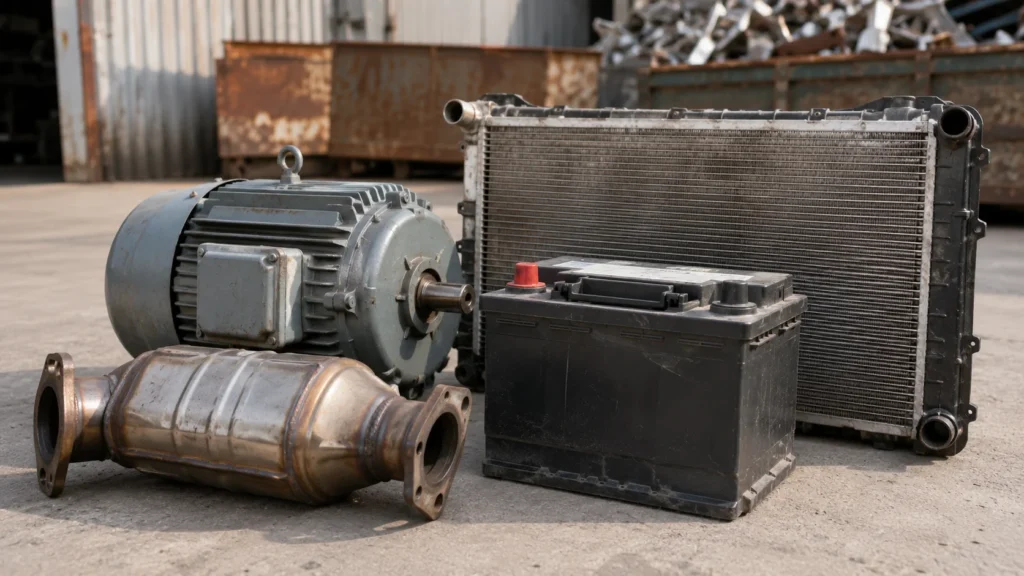
- Don’t bin the “boring” items. Car batteries, catalytic converters, electric motors and radiators are often the most valuable things on the trailer.
Scrap metal prices in Adelaide right now
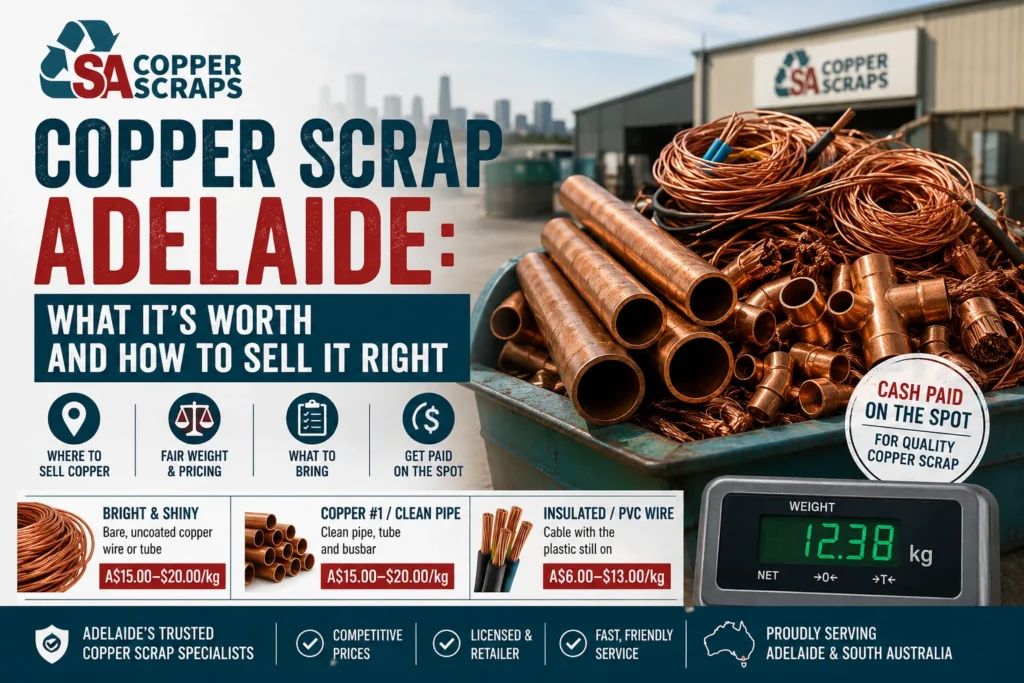
Below are the indicative public benchmark ranges displayed on the SA Copper Scraps price hub in July 2026. They are not guaranteed payouts. The final SA Copper Scraps price is confirmed in store after the material is inspected, graded and weighed. Prices can also move with commodity markets, the Australian dollar, local demand, grade, cleanliness and quantity.
| Material | Indicative range (per kg) | What moves it within the range |
| Copper — bright & shiny | A$15.00 – A$20.00 | Clean, bright copper without coating, solder, paint or contamination. |
| Copper #1 / clean pipe | A$15.00 – A$20.00 | Clean copper pipe, busbar and heavier copper without solder or contamination. |
| Copper PVC wire | A$6.00 – A$13.00 | The range depends heavily on copper recovery and plastic content. |
| Brass | A$9.00 – A$13.00 | Clean taps, valves and fittings; plating and steel inserts can reduce value. |
| Aluminium — extrusion | A$3.00 – A$4.50 | Clean frames and profiles without steel, rubber or other attachments. |
| Aluminium — domestic | A$3.00 – A$5.00 | Mixed household aluminium, sheet and light domestic material. |
| Mag wheels | A$2.00 – A$3.50 | Tyres and steel attachments can reduce the assessed value. |
| Lead | A$2.00 – A$2.50 | Sheet, flashing and wheel weights, depending on cleanliness. |
| Steel / ferrous | A$0.15 – A$0.40 | Light steel generally sits lower than clean, heavy prepared steel. |
| Electric motors | A$1.50 – A$2.20 | Value varies with copper winding, casing, size and attachments. |
| Car batteries | A$0.50 – A$1.00/kg | Public Adelaide benchmark; bulk quantities are assessed separately. |
| Catalytic converters | Quoted per unit | Valued on make, model and internal composition — see the converter page. |
| Air conditioner units | Quoted per unit | Valued on the copper coil and compressor inside — details here. |
| Compressors | Quoted per unit | Sealed fridge and aircon compressors — current rates. |
Important: These ranges are public guidance only. Call 08 7225 9998 or request a quote before visiting. Final pricing depends on the material presented and is confirmed after inspection, grading and weighing.
Public guide ranges shown are indicative as displayed in July 2026 and are confirmed only after material is inspected, graded and weighed in store. Per-metal pages carry the current detail: copper · brass · aluminium · lead · steel · cable · batteries · radiators · electric motors · mag wheels · general metals.
Why the price changes from week to week
Scrap pricing is not arbitrary, and understanding the four inputs makes it much easier to judge whether an offer is fair:
- Global commodity markets. Copper, aluminium and lead are traded on the London Metal Exchange. When LME copper rises, Adelaide scrap copper follows within days.
- The Australian dollar. Metals are priced in US dollars. A weaker AUD lifts local scrap prices even when the underlying metal hasn’t moved.
- Shipping and processing costs. Freight rates, energy costs and container availability all sit between the yard and the smelter.
- Local supply. After a big demolition or a construction downturn, regional supply spikes and local rates soften independently of world markets.
We break this down in more depth in what actually sets the copper rate in Adelaide. The practical takeaway: if you are sitting on a large quantity and you are not in a hurry, it is worth a phone call before you load the trailer.
Ferrous or non-ferrous? The three-second magnet test
This is the single most useful thing a first-time seller can learn, and it needs nothing more than a fridge magnet.
| Ferrous | Non-ferrous | |
| Magnet test | Sticks | Does not stick |
| Contains | Iron | No significant iron |
| Typical metals | Steel, cast iron, wrought iron | Copper, brass, aluminium, lead, zinc, stainless* |
| Everyday examples | Roof sheeting, RSJs, car bodies, old fencing, appliance shells | Water pipe, wiring, window frames, taps, radiators, drink cans |
| Relative value | Cents per kilo | Dollars per kilo — often 10–50× higher |
| Corrodes to | Rust | Tarnish or oxide film |
*Most stainless steel is only weakly magnetic or non-magnetic, which trips people up. If a magnet grips weakly and the metal is bright and hard, set it aside and let the yard identify it rather than throwing it on the steel pile.
Everything valuable on a typical load is non-ferrous. Separating the two piles before you arrive is what stops your copper being weighed in at the steel rate.
What each metal is worth — and what pulls the price down
Copper
Copper is the highest-paying common metal in Adelaide and the reason most people visit a yard at all. It turns up as water pipe, electrical wiring, hot water cylinder linings, roofing, guttering and busbar. Yards grade it strictly, and the gap between grades is real money — see the scrap copper page for what we accept, and copper cable for wire specifically.
Raises the price: stripping insulation fully · removing solder, brass fittings and steel brackets · keeping it dry and free of paint · separating bright shiny from tarnished before you arrive.
Lowers the price: soldered joints · attached fittings · burnt or heavily oxidised surfaces · tar, paint or lagging still attached.
Brass
Brass is a copper-zinc alloy, noticeably heavier than aluminium and gold-toned under the tarnish. It comes from taps, valves, plumbing fittings, door hardware, gauges and marine fittings. It pays well but below copper. Full detail on the scrap brass page, and we wrote about the grades in brass scraps at SA Copper Scraps.
The most common downgrade is chrome-plated brass — a plated tap looks like steel but is brass underneath. Scratch an inconspicuous edge; if it is yellow beneath, it is brass. The second is steel inserts inside valve bodies, which have to be removed or the whole item is graded as dirty brass.
Aluminium
Light, non-magnetic and never rusts. Sources include window and door frames, ladders, boat and trailer parts, engine components, sheet and cans. Because it is light, aluminium rewards volume rather than weight — a full trailer may not be heavy, but clean extrusion is a solid earner. See scrap aluminium.
Keep extrusion separate from cast (engine blocks, gearbox housings) and from domestic sheet. They are three different rates, and mixing them means being paid at the lowest. Strip out rubber seals, plastic thermal breaks and steel screws from window frames — that one step alone can lift a load a full grade. Mag wheels are cast aluminium and are priced separately again.
Lead
Dense, dull grey, soft enough to mark with a fingernail. Found as roof flashing, wheel balance weights, old plumbing, sinkers, diving weights and cable sheathing. Handle it with gloves and wash your hands afterwards. Rates on the scrap lead page.
Insulated cable and copper wire
Cable is the grade people most often misjudge. When you sell insulated cable you are being paid for the copper inside, so the rate reflects the recovery percentage — thick house wiring and heavy-gauge industrial cable carry far more copper per kilo than thin data or speaker cable, and are priced accordingly. Details on the insulated cable page and in our guide to getting cash for scrap wire.
Should you strip it yourself? For heavy-gauge cable in decent quantity, yes — bare bright copper pays materially more. For thin, fiddly cable, the labour usually costs more than the uplift. Bring it in and we will tell you honestly which side of that line your load falls on. Never burn insulation off: it is illegal, it releases toxic fumes, and burnt copper is downgraded anyway.
Steel and general scrap
Steel pays the least per kilo but arrives in the largest quantities — sheeting, fencing, structural offcuts, appliance shells, old machinery. On a site clean-up or a shed clear-out, steel volume can still add up to a worthwhile cheque, and it clears the space. See scrap metals and the steel price page.
The high-value items most people throw away
These are the items that go in the skip on a typical clean-up and shouldn’t. Individually they look like junk; collectively they are often the best-paying part of a load.
| Item | Why it’s worth money | Page |
| Car batteries | Lead-acid batteries are roughly 60% recoverable lead by weight and are accepted whole. | Batteries |
| Catalytic converters | Contain platinum, palladium and rhodium. Priced per unit on make and model — among the highest-value single items on any car. | Converters |
| Electric & starter motors | Copper windings inside a steel casing. Worth well above the steel rate without you having to open them. | Motors |
| Fridge & aircon compressors | Dense sealed units with copper and steel. Heavy, so they add up quickly. | Compressors |
| Air conditioner units | Copper coil plus compressor. Must be professionally degassed before recycling. | Air con units |
| Radiators & coils | Copper/brass or aluminium construction — well above general scrap rates. | Radiators |
| Mag wheels | Cast aluminium alloy. Remove tyres and steel weights first. | Mag wheels |
| Hot water systems | Older units often have a copper cylinder inside a steel jacket. | Scrap metals |
How grading works — and why it decides your payout
Grading is the assessment of a metal by type, purity, cleanliness and preparation. It is not a haggling tactic; it reflects what the material costs the downstream smelter to process. Contamination has to be removed by someone, and if it isn’t you, the cost comes out of the rate.
The principle is the same for every metal: the cleaner and more consistent the material, the closer to the top of the range it lands.
| Grading tier | What it means | Typical cause of a downgrade |
| Clean / prepared | One metal, one grade, nothing attached. Ready to process as-is. | — |
| Mixed or lightly contaminated | The right metal, but with paint, solder, oxidation or another grade mixed through it. | Not separating grades before arriving |
| Irony / attached | Non-ferrous metal still fixed to steel, or heavily coated, tarred or burnt. | Leaving brackets, screws and steel inserts in place |
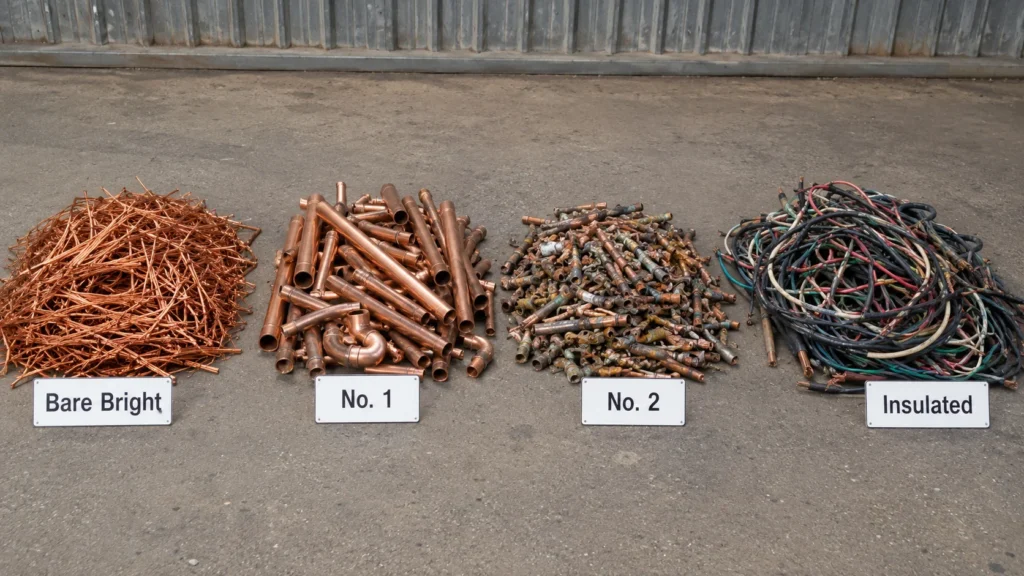
Copper is where this matters most, because it has the widest spread between grades — bare bright, #1, #2 and insulated wire are four different rates on the same metal. We covered that in detail in copper scrap prices in Adelaide: what actually sets the rate, which is worth reading before you bring in a copper load.
The single biggest grading mistake
One steel bracket left on an otherwise clean copper item can move the whole piece into “irony copper”. On a 20 kg lot that is the difference between top rate and a fraction of it. Five minutes with an angle grinder or a hacksaw before you load is the highest hourly rate you will earn all week.
How to prepare your scrap for the maximum payout
Work through these in order. On a normal domestic or trade load it takes twenty to forty minutes and it is the difference between the mixed rate and the graded rate.
- Empty everything out. Tip out water, oil, fuel and concrete. Liquids and fill are dead weight that the yard has to deal with, and fuel is a genuine hazard.
- Run the magnet. Two piles: sticks and doesn’t stick. Do this first — it makes every step after it faster.
- Split the non-ferrous pile by metal. Copper, brass, aluminium, lead. Separate containers, tubs or bags. This is where the money is.
- Split by grade within each metal. Bright copper apart from tarnished. Aluminium extrusion apart from cast apart from domestic sheet. Clean brass apart from plated or steel-inserted brass.
- Remove attachments. Steel screws and brackets off aluminium frames. Rubber seals and plastic thermal breaks out. Steel inserts out of brass valves. Tyres and steel weights off mag wheels.
- Decide on stripping cable. Heavy-gauge cable in quantity is worth stripping. Thin cable usually isn’t. Never burn insulation — it is illegal, it is toxic, and it downgrades the copper.
- Weigh and photograph before you leave. A rough weight and a few phone photos give you a reference point and make a phone quote far more accurate.
Safety on the job
Cut-resistant gloves, closed footwear and eye protection are the minimum. Old sheet metal edges are genuinely dangerous and treated timber, insulation and lagging can hide worse. If you are pulling apart anything sealed, pressurised or refrigerant-charged, stop and get a licensed technician — see the next section.
What not to bring to an Adelaide scrap yard
Every legitimate yard in South Australia refuses these, and for good reason. Turning up with them wastes your trip at best.
- Gas bottles and cylinders — LPG, oxygen, acetylene, CO₂, fire extinguishers. Sealed pressure vessels can explode when cut or crushed. Return them to a supplier or an authorised collection point.
- Any sealed or pressurised vessel — receivers, accumulators, hydraulic rams and drums that haven’t been opened and drained.
- Fuel tanks with residue — vapour is the hazard, not the liquid. Tanks must be professionally purged.
- Undegassed refrigeration equipment — fridges, freezers and air conditioners must be degassed by a licensed technician before they can be processed. Refrigerant release is a serious offence.
- Asbestos-containing material — old sheeting, lagged pipework and some brake components. Requires licensed removal and disposal.
- Radioactive sources and ammunition — industrial gauges, old smoke detectors in bulk, live rounds and ordnance. Contact SAPOL.
- Chemical drums and contaminated containers — anything that held solvents, pesticides or unknown substances.
- Electronic waste with batteries installed — remove lithium batteries first; they are a serious fire risk in a crusher.
If you are not sure what something is, don’t cut it and don’t guess. Photograph it and call us — we would far rather answer the question than have you take a risk with it.
South Australia’s Scrap Metal Dealers Act 2025: what sellers need to know
South Australia’s Scrap Metal Dealers Act 2025 received assent on 4 December 2025, but it has not yet come into operation. SAPOL currently says commencement is expected in 2028 and that there are no new changes industry participants or customers need to follow at this time.
What the Act is expected to introduce
Once the Act commences and the supporting regulations are finalised, the framework is expected to introduce:
- Registration and probity requirements for prescribed scrap metal dealers.
- Restrictions on cash, cryptocurrency and other non-traceable payment methods for prescribed scrap-metal transactions.
- Seller-identification and transaction-record requirements.
- Greater police inspection, enforcement and closure powers.
The detailed obligations and the exact commencement date may change as regulations are developed. Check official SAPOL and South Australian legislation updates before relying on these future requirements.
What that means for sellers today
- The Act does not currently create a new statewide requirement for every seller to provide ID or receive payment electronically.
- A yard may still request photo identification, proof of ownership or transaction details under its existing business procedures.
- For large or unusual loads, especially bulk copper, cable or catalytic converters, be ready to explain where the material came from.
- Ask the yard about its current accepted payment methods before visiting.
Why a clear transaction process is in your interest
Clear identification, grading, weighing and payment records can protect honest sellers and legitimate recyclers. They reduce disputes, make it easier to understand how a load was assessed and discourage stolen material from entering the recycling chain. This information is general only and is not legal advice. For the current position, use the official SAPOL Scrap Metal Dealers Act update and the South Australian Legislation website.
How to choose a scrap metal recycler in Adelaide
Rates advertised online are only half the story. What determines your actual payout is how the yard weighs, grades and pays. Use this checklist:
- Trade-certified scales. Weighing equipment used for trade must be verified. Ask to see the certification — a legitimate yard will show you without hesitation.
- Grading explained in front of you. You should be able to see how your load was categorised and ask why. If grading happens out of sight, that is a problem.
- Published price ranges. A yard willing to publish its rates is a yard willing to be held to them.
- A clear payment process. Ask how and when payment is finalised after grading and weighing.
- Transparent business procedures. A reputable yard can explain its current ID, ownership and payment requirements.
- A proper site. Sealed hardstand, safe vehicle access, bunding and clear separation of materials. A yard that manages its own environmental obligations is a yard that will handle your load properly.
- Real reviews and a real address. A physical site you can drive to, consistent trading hours, and a name attached to the business.
What to look for before you sell
- Check that the buyer has a verifiable business name, physical address and contact details.
- Ask to see the weight and understand how each material was graded.
- Confirm the rate, deductions and payment method before finalising the sale.
- Be cautious of a quote that is far above published market guidance but cannot be explained.
Selling your scrap metal: what actually happens
- Sort at home using the steps above. This is the part that pays.
- Call ahead for anything unusual — a large volume, a catalytic converter, a whole vehicle, or something you can’t identify. Contact us on 08 7225 9998.
- Drive in to 12 Belfree Dr, Green Fields. Ute, trailer, van or truck — the site is built for vehicle access.
- Weigh in. Your load is weighed on certified equipment with the reading visible to you.
- Grading and inspection. Materials are assessed by type and grade. Ask questions — it is your load and you should understand the assessment.
- Get your quote. Confirmed rate per kilo, per metal, against the current market.
- Confirm the transaction. Provide identification if requested, confirm the final grade and weight, and complete payment using the yard’s current process.
Have a look at the yard gallery to see the site before you come, or read our walkthrough on how to get top cash for scrap metals in Adelaide.
Scrapping a car, ute or truck
A whole vehicle is the largest single scrap item most people will ever sell, and it does not need to be running, registered or roadworthy. SA Copper Scraps handles eligible vehicles through its vehicle-buying services. Removal availability and any collection conditions should be confirmed when you request a quote.
- Car removal — collection may be available for eligible vehicles; confirm your suburb and vehicle details.
- Cash for cars — valuation and payment on collection.
- Scrap car buyers — end-of-life vehicles in any condition.
- Damaged and non-running cars — accident, flood or mechanical write-offs.
- Unregistered vehicles — no rego required.
- Junk car removal — clear the yard or driveway.
- Cash for scrap trucks — light commercial through to heavy rigid.
Before the truck arrives: clear personal belongings, remove the plates, and cancel the registration with Service SA. Keep the catalytic converter and battery in mind — they are valued as part of the vehicle, so make sure they are accounted for in the quote.
Where we buy across Adelaide
Our yard is at Green Fields in Adelaide’s north, and we buy from across the metropolitan area and the Adelaide Hills — trade and domestic alike. The full list is on the service areas page, and includes Port Adelaide, Glenelg, Morphett Vale, Tea Tree Gully, Seaford and Mount Barker, among more than forty suburbs.
Builders, electricians, plumbers, air-conditioning contractors, auto workshops and demolition crews can bring sorted material to the Green Fields yard. Call ahead about unusually large trade or commercial loads.
What recycling metal actually saves
Metal is one of the few materials that can be recycled indefinitely without degrading. A copper pipe recycled today can be electrical wire next year with no loss of quality. The savings against producing the same metal from ore are substantial:
| Metal | Energy saved vs. producing from ore | Also avoided |
| Aluminium | Around 95% | Bauxite mining, alumina refining, red mud |
| Copper | Around 85% | Ore extraction, smelting emissions, tailings |
| Steel | Around 60–75% | Iron ore, coking coal and limestone extraction |
| Lead | Around 60% | Mining and primary smelting emissions |
Recycling one tonne of steel is commonly estimated to conserve in the order of 1,100 kg of iron ore, 630 kg of coal and 55 kg of limestone. At the scale of a working scrap yard, that adds up quickly — and it keeps material out of landfill in a state with some of Australia’s most ambitious waste diversion targets. Every load that comes across our weighbridge is material that stays in circulation instead of being buried.
Five mistakes that cost Adelaide sellers money
- Arriving with a mixed load. The most expensive mistake there is. Unsorted metal gets graded to the lowest common denominator.
- Burning insulation off cable. Illegal, hazardous, and burnt copper is graded down. There is no version of this that works in your favour.
- Binning the small stuff. Batteries, converters, motors, compressors and radiators are routinely thrown out by people who then sell the steel shell they came in.
- Selling at the bottom of the market. If the load is large and you are not under time pressure, ring for a rate before you load.
- Chasing an unrealistic quote. A rate well above everyone else usually gets corrected at the weighbridge — after you have driven there. Compare published ranges, not phone promises.
Frequently asked questions
What is the most valuable scrap metal in Adelaide?
Copper, by a wide margin among common metals. The current public guide shows clean bright copper at A$15.00–A$20.00 per kilo, brass at A$9.00–A$13.00 and domestic aluminium at A$3.00–A$5.00. These are indicative benchmarks rather than guaranteed SA Copper Scraps payouts. Catalytic converters can be worth more per unit than any of them, but they are valued individually rather than by weight.
Do I need ID to sell scrap metal in South Australia?
The Scrap Metal Dealers Act 2025 has not commenced, so its future identification rules are not yet a new statewide requirement. However, SA Copper Scraps may request photo ID or proof of ownership under its current procedures, particularly for unusual or high-value material. Call ahead if you are unsure what to bring.
Can I still be paid in cash for scrap metal in Adelaide?
The new Act’s payment restrictions are not yet in operation. SAPOL currently expects the Act to commence in 2028. Ask SA Copper Scraps about its current accepted payment methods when you call for a price.
How much scrap metal do I need before it’s worth bringing in?
There is no minimum. Small domestic loads are welcome. That said, non-ferrous metals are where the value is — a few kilos of copper is worth more than a full trailer of light steel, so it is worth checking what you have before deciding it isn’t worth the trip.
Should I strip the insulation off copper wire myself?
For heavy-gauge cable in reasonable quantity, yes — bare bright copper pays materially more than insulated. For thin cable, the labour usually outweighs the gain. Bring it in and we will tell you which applies. Never burn insulation off.
How do I tell copper from brass?
Colour is the quickest test: copper is reddish-orange, brass is yellow-gold. Under tarnish, scratch a hidden edge and look at the fresh metal beneath. Brass is also harder and rings when struck; copper is softer and duller in sound.
Is stainless steel magnetic?
Usually not, or only weakly. That catches people out because it is still a steel. If a magnet grips weakly and the metal is bright and hard, put it aside separately and let the yard identify it rather than assuming it is ordinary steel.
Do you take fridges and air conditioners?
Yes, once they have been degassed by a licensed technician. Refrigerant cannot legally be released to atmosphere. Undegassed units can’t be processed. See our air conditioner and compressor pages.
Can I sell a car without registration or roadworthy?
Yes. SA Copper Scraps buys eligible unregistered and non-running vehicles. Removal availability depends on the vehicle and service area, so confirm it when requesting a quote. Remove the plates and cancel the registration with Service SA.
How are scrap metal prices set?
London Metal Exchange commodity prices, the AUD/USD exchange rate, processing and freight costs, and local supply and demand. Grade and cleanliness then determine where within the range your specific load lands. More detail in what sets copper scrap prices in South Australia.
What can’t I bring to the yard?
Gas bottles and cylinders, sealed or pressurised vessels, fuel tanks with residue, undegassed refrigeration equipment, asbestos-containing material, radioactive sources, ammunition, chemical drums and devices with lithium batteries still installed. If in doubt, photograph it and call first.
What are your opening hours?
Monday to Saturday 7:30am–5:00pm, closed Sunday. We are at 12 Belfree Dr, Green Fields SA 5107.
Get a price for your scrap metal today
Sort it, load it, and bring it in. You will see your load weighed on certified scales, you will have the grading explained to you, and payment can be finalised after the grade and weight are confirmed.
SA Copper Scraps — Adelaide
Address: 12 Belfree Dr, Green Fields SA 5107
Phone: 08 7225 9998
Email: info@sacopperscraps.com.au
Hours: Mon–Sat 7:30am – 6:00pm · Sun closed
Current rates: View the current price guide
Not sure what you have? Send us a photo. We buy copper, brass, aluminium, lead, cable, batteries, catalytic converters, radiators, electric motors, mag wheels and general scrap metal — plus complete vehicles, with removal availability confirmed during the quote.

One Response