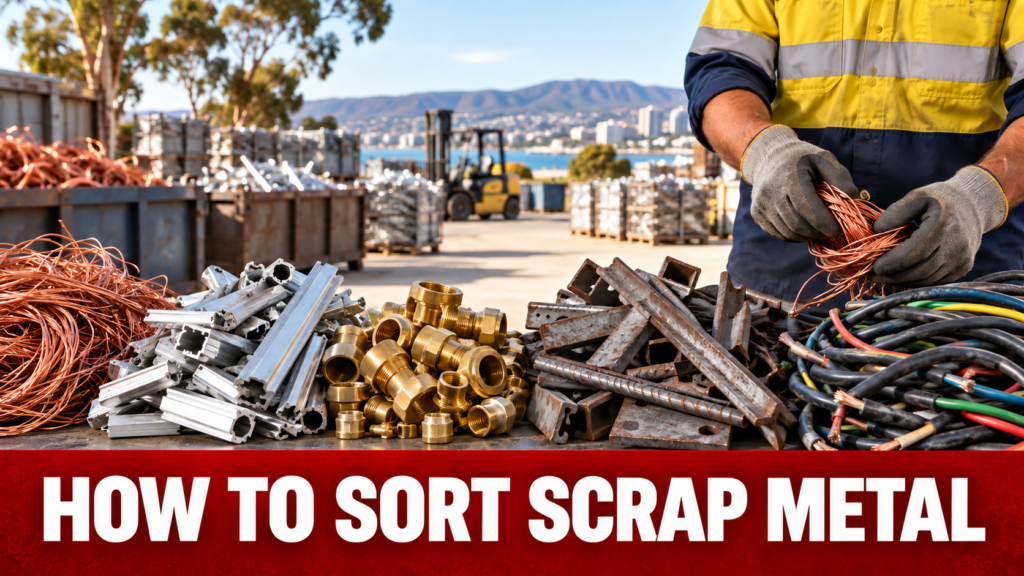
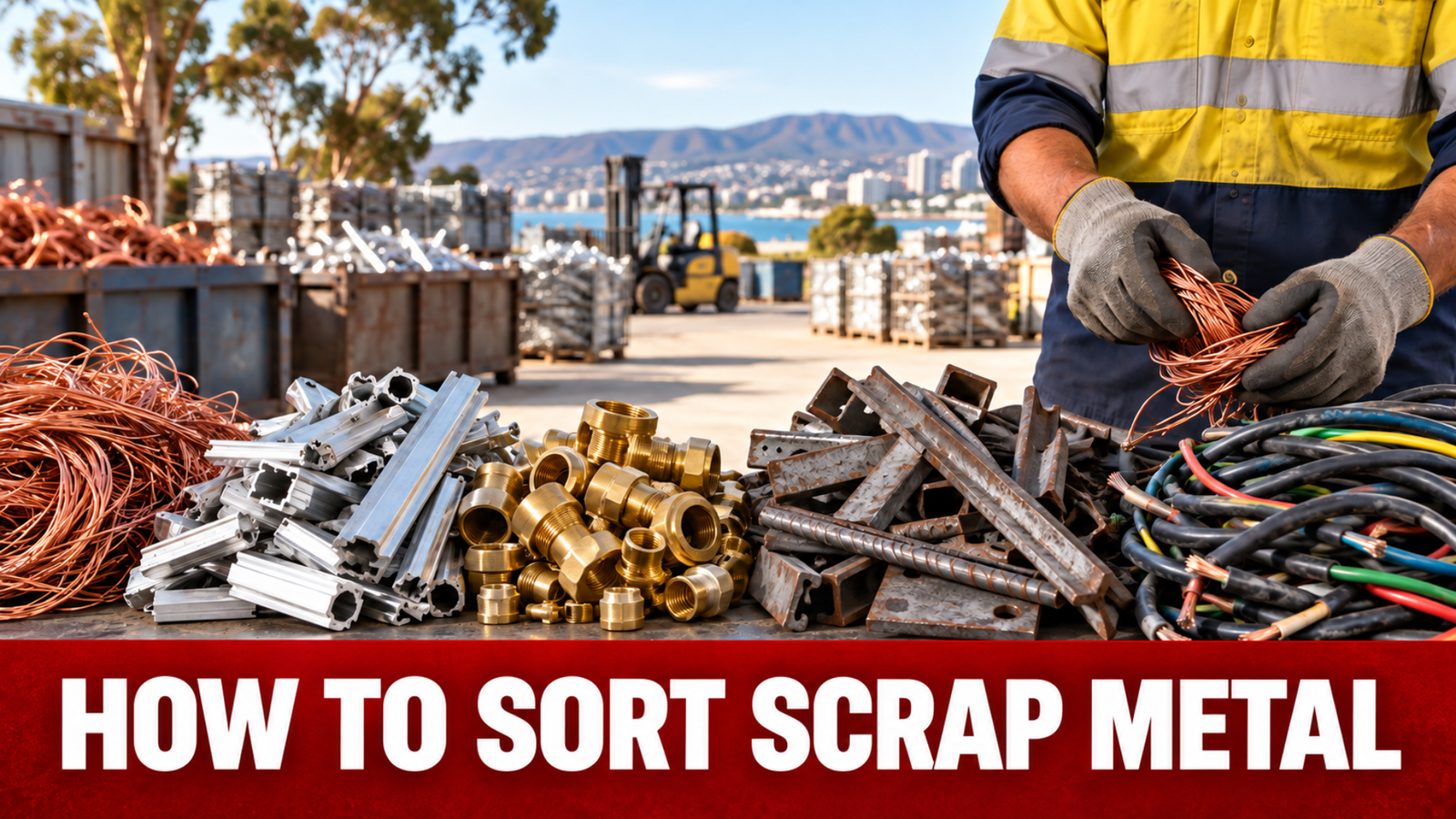
Sorting scrap metal before you sell it is the single biggest thing you control over what you get paid. A mixed bin gets graded toward its lowest-value contents. The same bin, separated into five piles, gets each pile priced at its own rate.
This is the practical guide to doing that at home — with nothing more than a fridge magnet, your eyes, and about ten minutes.
Why sorting changes the price
A scrap yard pays by grade, and grade depends on what is actually in the load. Copper can be worth fifty times what steel is worth per kilo. Mix them in one container and the yard has two choices: spend time separating it, or price the whole lot conservatively.
Either way the cost lands on you. Sorting before you arrive removes the guesswork, speeds up grading, and means each metal is paid at its own rate rather than averaged down.
It also tells you, before you drive anywhere, roughly what the trip is worth. That alone saves a lot of wasted journeys with a trailer of mostly steel.
Step 1: The magnet test
Start here. Get any fridge magnet and run it over everything.
Magnet sticks — the metal is ferrous. That means steel or iron. Worth cents per kilo, so it goes in its own pile.
Magnet does not stick — the metal is non-ferrous. Copper, brass, aluminium, lead or stainless. Worth dollars per kilo, and worth identifying properly.
This one test splits your load into its low-value and high-value halves in seconds. Everything after this step is about the non-magnetic pile.
A weak or partial pull usually means stainless steel. Most common stainless grades are only faintly magnetic or not magnetic at all, and stainless is worth considerably more than mild steel — so do not throw it in the steel pile by reflex.
Step 2: Identify the non-magnetic metals
Once you have the non-ferrous pile, colour and weight do most of the work.
| Metal | Colour | Weight | Where it comes from |
|---|---|---|---|
| Copper | Reddish-orange | Heavy | Plumbing pipe, electrical wire, hot water tanks |
| Brass | Yellow-gold | Heavy | Taps, valves, fittings, door hardware |
| Aluminium | Silvery-white | Very light for its size | Window frames, sheet, cans, wheels |
| Lead | Dull blue-grey | Unusually heavy, soft | Flashing, wheel weights, old pipe |
| Stainless steel | Bright silver | Heavy | Sinks, benchtops, food equipment |
If you are unsure, the scratch test helps. Scratch an inconspicuous spot — solid metal is the same colour all the way through, while plated items show a different metal underneath.
Each metal has its own guide covering grades and value: copper, brass, aluminium, lead and steel and stainless.
Step 3: Pull out the components
Some items should never go in a general metal pile, because they are assessed individually rather than by weight:
Electric and starter motors — valued on the copper winding inside. See what electric motors are worth.
Radiators — copper-brass and aluminium radiators price very differently. See radiator scrap value.
Air conditioners — copper coils, aluminium fins and a compressor in one unit. See getting rid of an old air conditioner.
Alloy wheels — clean aluminium once tyres and weights are off. See mag wheel scrap value.
Car batteries and catalytic converters — assessed per unit, and both need specific handling.
Mixing these into a general load either loses their value or slows the whole assessment down.
Step 4: Remove attachments where it is safe
Attachments drag a metal down a grade. The most common examples:
Brass fittings and solder left on copper pipe drop it from #1 to #2 copper.
Steel screws and brackets left on aluminium frames reduce the aluminium grade.
Plastic, rubber and insulation add weight without adding metal.
Tyres and wheel weights left on alloy wheels have to be removed before weighing.
Only remove what is safe and practical. Nothing needs to be dismantled with dangerous tools, and the yard can separate small amounts on arrival. For cable specifically, our guide on whether to strip copper wire covers when stripping pays and when it does not.
Step 5: Contain, label and keep it dry
Put each metal in its own bucket, bag or crate. It does not need to be tidy — it needs to be separate.
Keep everything dry and under cover. Wet material weighs more on the scales but grades worse, and yards account for moisture. Rusty steel and oxidised copper also grade lower than clean material.
When you arrive, tell the team what is in each container. It takes seconds and it means your sorting gets recognised rather than re-checked from scratch.
What is worth sorting, and what is not
Sorting has diminishing returns. A practical rule:
| Worth the effort | Not worth the effort |
|---|---|
| Separating copper from everything else | Sorting a small bucket of mixed steel |
| Cutting fittings off copper pipe | Polishing or cleaning metal for appearance |
| Pulling motors and radiators out of a load | Stripping thin flex by hand |
| Checking whether 'steel' is actually stainless | Dismantling anything that needs power tools |
The biggest gains come from the first split — ferrous from non-ferrous — and from getting copper into its own container. After that, returns drop quickly.
Bringing sorted scrap to the yard
At SA Copper Scraps, 12 Belfree Dr, Green Fields SA 5107, sorted loads are graded quickly and each metal is weighed and priced separately on calibrated scales while you watch.
Bring photo ID.
Call 08 7225 9998 first for anything over a few hundred kilos.
Open Monday to Friday 7:30am—5:00pm and Saturday 7:30am—2:00pm. No appointment needed.
For current rates on every material, see the scrap prices hub.
Frequently asked questions
How do I sort scrap metal at home?
Start with a magnet — anything it sticks to is steel or iron and goes in one pile. Sort the rest by colour and weight: reddish-orange is copper, yellow is brass, very light and silvery is aluminium, and very heavy dull grey is lead. Pull out motors, radiators and batteries separately.
What is the difference between ferrous and non-ferrous metal?
Ferrous metals contain iron, are magnetic, and are worth cents per kilo — mainly steel and cast iron. Non-ferrous metals contain no iron, are not magnetic, and are worth dollars per kilo — copper, brass, aluminium and lead.
How do I tell copper from brass?
Colour is the quickest test. Copper is reddish-orange, like a new coin. Brass is yellow-gold. Both are non-magnetic and both are heavy, but copper is worth considerably more per kilo.
How can I tell if metal is aluminium?
Aluminium is silvery, non-magnetic and noticeably light for its size. If a piece looks like steel but a magnet will not stick and it feels surprisingly light, it is almost certainly aluminium.
Is stainless steel magnetic?
Most common stainless grades are only faintly magnetic or not magnetic at all. A weak pull usually means stainless, which is worth considerably more than ordinary steel — so check before putting it in the steel pile.
Does sorting scrap metal really increase the price?
Yes. Mixed loads are graded toward their lowest-value contents because the yard cannot price what it cannot separate. Sorted loads let each metal be paid at its own rate.
Do I have to sort scrap metal before selling it?
No — mixed loads are accepted. But sorting usually means a clearer grade and a better result, particularly when copper is involved.
Should I clean scrap metal before selling?
Not for appearance. Grading is about contamination, not shine. Removing attachments like fittings, screws and plastic helps; polishing does not.
What should I keep separate from general scrap?
Electric motors, radiators, air conditioners, alloy wheels, car batteries and catalytic converters. Each is assessed individually rather than weighed in with general metal.
Where can I sell sorted scrap metal in Adelaide?
SA Copper Scraps at 12 Belfree Dr, Green Fields SA 5107. Each sorted metal is graded and weighed separately on calibrated scales, and payment is made before you leave.
Final word
Ten minutes with a magnet and a few buckets is usually the best-paid ten minutes of the whole job. Split the magnetic from the non-magnetic, get the copper into its own container, pull the components out, and bring it in dry.
Call 08 7225 9998 for today's rates, or see the full price guide.